Connect with us

articles

Pakistan’s Zero Sum Game – Some Historical Perspectives-1

Published

on

Author: Dr. Subroto Gangopadhay

Press Release:  http://indiafacts.org/pakistans-zero-sum-game-historical-perspectives-1/

Pakistan and India fought the first Kashmir war between October 1947 and December 1948. At the time of independence, the princely state of Jammu and Kashmir was independently ruled by Maharaja Hari Singh, of the Dogra dynasty. The ruler had the option of remaining independent, joining India or Pakistan. Jammu and Kashmir, demographically had a predominantly a Muslim population, mostly converted during the five centuries of Muslim rule over the region that preceded the hundred years Hindu Dogra rule at the time of independence. Hari Singh was undecided about the path he wanted to choose for his kingdom. The Muslim rebellion soon broke out in Jammu and was the pretext of the Tribal Muslims (Pashtuns from NWFP mostly) and the Pakistani Army to cross over to capture the state. They had begun to run over Hari Singh’s forces. The King appealed to India to respond with military help, and in return signed the formal instrument of accession with India, as required by India, on 26th October, 1947. Indian forces thereafter entered and the protracted battle continued over a year before the formal ceasefire on Jan 1, 1949. At that time, Pakistan had gained significant territory, though India had the majority. At the beginning of the 1947 invasion, the Pakistani forces had advanced without problems before the first resistance at Uri. Pakistan has not halted its campaign since, nor has the theatre of war changed.

Pakistani identification with Caliphate

Pakistan launched Operation Gibraltar in the late summer of 1965. Pakistani Army had a regiment called Azad Kashmir Regimental Force that today is called Azad Kashmir Regiment. The operation was named after Umayyad conquest of Spain, launched from the Port Of Gibraltar in 711. The symbolism has little to do with India or Pakistan’s own history, but refers to the Pakistani State’s identification with the history of the expansion of the Caliphate. In operation Gibraltar, about 30,000 Pakistani troops infiltrated Kashmir as guerilla fighters, confident that their visions of an Islamic Caliphate will resonate with the majority Muslim population of Kashmir and that an open rebellion would lead to Kashmir’s secession. The operation was a spectacular failure, as the Kashmiris had a greater respect and identification with their own history than that of the Arabian Caliphate. This failed operation launched the Indo-Pakistan war of 1965, with a ceasefire, brokered at the UN by USA and USSR.  By the time the ceasefire was declared, India had the upper hand in the three weeks, ferocious conflict. The Tashkent declaration of 1966 followed. India lost Prime Minister Lal Bahadur Shastri in Tashkent, a national tragedy that has escaped the period historians. The 1965 conflict was the result of Zulfikar Ali Bhutto’s conviction that after India’s capitulation to the Chinese forces in 1962, Pakistan could inflict a decisive defeat on India. He had successfully persuaded President, Marshall Ayub Khan to his point of view. Ayub Khan referred to the infiltrators as Bhutto’s Mujahids.

Operation Searchlight – Genocide and Rape of Bengalis

Pakistan’s disastrous cultural blindness and rejection of East Pakistan’s due political, executive and economic rights, led to disaffection and desire for cessation. In the 1970 general elections in Pakistan, despite winning 167 of 169 seats in E Pakistan, and hence an absolute Majority in Pakistani Parliament of 313 elected members, ZA Bhutto (People’s Party) and President, Gen Yahya Khan refused Sheikh Mujibur Rehman, his due right of becoming Pakistan’s Prime Minister. Yahya, a personal friend of Nixon, responded by unleashing a pogrom on the rightfully dissenting East Pakistanis. The Punjabi (and West Pakistan) dominated Military were set upon their own countrymen in E Pakistan. Operation Searchlight launched the infamous genocide of Bengalis (selectively targeting Hindus), in which a reported two to three million were slaughtered. Countless women were raped and ten million refugees entered West Bengal, causing enormous hardship to the state and India’s economy. The world remained silent in the face of this humanitarian disaster.

American complicity in Indo-Pak war of 1971

The East Pakistanis in the Pakistan army defected and formed part of the Mukti Bahini that India supported. Indira Gandhi, India’s Prime minister, was rebuffed by the American Administration of Nixon and Kissinger, both of whom personally despised her. When Indira Gandhi visited Washington in November 1971, Nixon made her wait 45 minutes before granting audience, and went on to extend his support to the largest genocide of human beings, since the Jews suffered at the hands of the Nazis. Nixon and Kissinger supported Pakistan, a member of the American led military pact CENTO and SEATO. In July 1971, Henry Kissinger had been to Beijing, where Zhou- En Lai went on record to say that they supported Pakistan and would not sit by idly, if India continued on its course of confrontation. It is also a matter of record that Mr. Kissinger confirmed American Support of Pakistan to the Chinese during this visit. On August 9, 1971, India signed the peace, cooperation and friendship treaty, with the Soviet Union, ending its formal policy of non- alignment.

Pakistan’s policy of naming military operations and missiles after Islamic invaders

For the record, India’s formal entry into the war in 1971 was in response to Pakistan launching Operation Chengiz Khan with attacks on 11 Indian airbases on December 3, 1971. Once again the symbolism of operation Chengiz Khan is unmistakable. Pakistanis indeed have forgotten that it is their forefathers, who suffered slaughter at the hands of the Mongol Invader. Instead, he was their hero, to be emulated, by invading India. This strange thought process also permeates their naming of missile systems after Ghazni, Gauri and so on.  Pakistan, to this day psychologically considers itself as the remnant lineage of the ‘glorious invading Islamic armies of antiquity’ that killed their forefathers as well.

As the war unfolded in 1971, the US advanced the 7th Fleet with the largest aircraft carrier in the world- USS Enterprise, with USS King, USS Tripoli, USS Decatur and USS Tartar Sam to threaten the Bay of Bengal, while the British Royal Navy sent its fleet led by EAGLE to threaten India’s West Coast. India was saved due to Soviet Intervention, with their nuclear-armed ships and submarines encircling the American Navy. This also warned off the Chinese, who had been requested by the Nixon administration to move their troops along India’s Northern borders.  Britain’s role was nefarious and the UN’s role non-existent.

But, Israel did send arms to India, despite India’s support to Arabs and failure to grant Israel diplomatic recognition until 1992.

Pakistan’s defeat and birth of radical jihadi warriors as state instruments

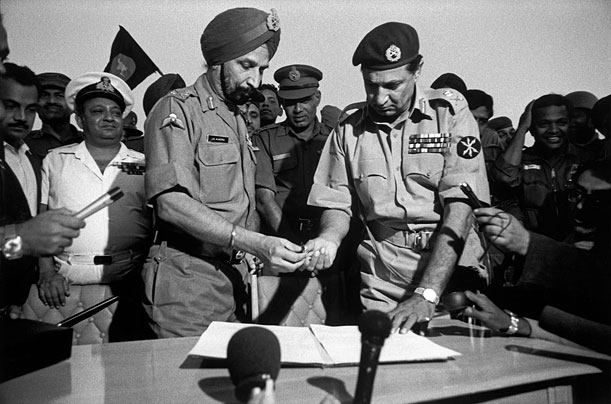
India’s decisive victory in 1971 and vivisection of Pakistan, was probably the most humiliating event in Pakistan’s history. Pakistani ruling elites seem to have harbored ambitions of creating an Islamic Caliphate with imposition of the Arab language, Arab Culture and Salafist ideology on their own people and advance the same beyond their borders. Imposition of a single foreign identity on Kashmiris, Baluchi’s, Sindhis and Pashtuns, like the Bengalis, is a delusional and destructive idea no different than ISIL’s goal of homogeneity. Imprisonment of Waseem Akhtar, the elected MQM Mayor of Karachi-the largest city and hub of commerce and culture- reflects the disconnect between the people, their choices and their state.

The 1971 war not only failed to bring circumspection, it actually led to greater reinforcement of failed ideas. It spurred the state into creating, nurturing, training, funding and using radical Islamic fundamentalist forces as an active arm of state policy. This was to be formally supported and organized with the help of the United States, determined to displace a Socialist, Soviet leaning regime from Afghanistan, as the seventies transitioned into the eighties. Gen Zia- Ul- Haq, who removed ZA Bhutto, with alleged American Support in 1977, remained the President from 1978 to 1988, where he became a firm ally in eliminating Soviets. This is the period, when the Pakistani ISI and the US oversaw the creation of an international Jihadi force of Taliban and Mujahedeen Warriors, as tools of the American foreign Policy. This was a symbiosis between the world’s most powerful democracy and the world’s most violent fundamentalist force. America and Pakistan were the parents of Taliban and of the development and promotion of Opium and Heroin trade as instruments of foreign policy (which the Taliban had actually opposed).  Pakistan became a pawn to American goals of planning the demise of the Soviets. In a quid pro quo, the US allowed promotion of the secession of Kashmir through violent jihadi outfits, which it co-created with the ISI.

Operation Tupac

Once the Soviets withdrew (1988-89) and the USSR officially broke up (December 1991), it became easy to redirect the Jihadis to the Kashmir theater under the new Operation Tupac, which had commenced officially in 1988, under the orders of Zia Ul Haq. Operation Tupac remains in existence to this day with its declared objectives of 1) Disintegrating India 2) Utilizing Spy networks for Sabotage and 3) Using the loose borders with Nepal and Bangladesh to set up bases and conduct operations. Operation Tupac has had great success in comparison to the failed Operation Gibraltar. It is also worth noting that the escalating Khalistan Movement that reached a peak in India in the 80’s had a Pakistani sponsorship with at least tacit US support. The Government of India had protested US involvement and the backing of Khalistan, in a formal protest, duly denied by George Bush Senior, US Vice president in 1984, during his India visit.

Conclusions:  

* Pakistan’s policy on Kashmir is a publicly declared state policy, e.g. Operation Tupac.  Covert and overt means have been used for more than 50 years and shall continue.

* Trying to prove Pakistan’s complicity in every attack is both redundant and self-defeating given the declared Pakistani policy seeking India’s disintegration.

*The incessant efforts to present evidence to the world makes India looks weak to the very powers that were complicit in letting this happen. It also offers a plausible deniability to Pakistan, which has never hidden its policy goals from the world. India’s interest in stirring debate is a poor cover for unwillingness to have a clear policy of response.

*The media, politicians and interlocutors of India have chosen to mislead their own country into a make-believe world of political solutions, peace and bonhomie through shared culture. They have deliberately obliterated the obvious history between India and Pakistan, since partition.

*To the amusement of the Pakistani Establishment, India stills coddles a culture, which the ruling Military- Jihadi elite in Pakistan, has proscribed for its own country. Officially, Pakistan has chosen to enforce an Arabic monoculture of language (Urdu), dress and theocratic dogma on its own citizens .The Baluchistan freedom struggle, the disaffection of Sindhis and Pashtuns are a testimony to Pakistan’s vision for itself. The creation of Bangladesh is testimony to the same.

* Why India’s left, secular intelligentsia, cultural vanguards, and political parties fail to digest a fairly compulsive set of simple historical facts remains unknown.

Photo credit: Nimblefoundation.org

Disclaimer: The facts and opinions expressed within this article are the personal opinions of the author. IndiaFacts does not assume any responsibility or liability for the accuracy, completeness, suitability, or validity of any information in this article.

Continue Reading

articles

UNDERSTANDING THE CHRONOLOGY OF RAIGADH WITH SPECIAL REFERENCE GIVEN TO ITS STRUCTURAL MONUMENTS

Published

on

Raigadh: A Journey Through Thirteen Centuries of Architectural Heritage

Nestled in the Sabarkantha district of Gujarat, the small village of Raigadh (23°36’17” N, 73°10’42” E) stands as a remarkable open-air museum of Indian architectural evolution. From the late 7th century to the 20th century, this humble settlement has accumulated an extraordinary collection of structural monuments that chronicle the reign of multiple dynasties and the transformation of religious beliefs and practices. By studying Raigadh’s monuments, we can trace the architectural innovations, iconographical changes, and cultural shifts that shaped North Gujarat’s history.

The Maitraka Legacy: The Mota Mahadev Temple


The oldest surviving monument in Raigadh is the Mota Mahadev temple, dating to the late 7th century CE during the Maitraka period. This Shiva temple exemplifies the Phamsana architectural style, featuring a distinctive Ksoni or Gandharic-type Shikhara (spire). The original Maitraka design consisted of a Shikhara and a Garbhagriha (inner sanctum), adorned with intricate sculptures of Ganesha and Maithuna (amorous couple) figures that reveal the artistic sophistication of this ancient dynasty. What makes this temple particularly significant is its continuous religious importance. Centuries later, during the Solanki period (10th century), the temple underwent substantial renovations. The Solanki additions included a Mandapa (entrance hall) with a Kakshasana (bench-like structure), complete with plain pillars topped with lotus patterns. This evolution reveals how temples were actively modified across generations, adapting to changing worship practices. The temple boasts sculptures from both periods, including a standing Ganesha from the Maitraka era and later additions like a Nandi (bull mount of Shiva), Pranala (water channel), and a goddess figure, likely Parvati. Though the temple has undergone modern renovations with lime mortar and cement, it remains a living temple, worshipped especially during auspicious occasions like Mahashivaratri.

The Saindhava Contribution: Kashi Vishwanath Temple

The 9th century witnessed the construction of the Kashi Vishwanath temple during the Saindhava period, reflecting the dynasty’s influence in North Gujarat. Built entirely in sandstone, this temple showcases a Phamsana Vimana with a Ksoni Phamsanakara Shikhara—a pyramidal or diamond-shaped design that distinguishes it from contemporary structures. The east-facing temple follows an architectural plan featuring a Vimana with a sanctum and no ambulatory path, representing a distinct approach to temple design. The sculptural program of this temple deserves particular attention. The northern wall displays Andhakasuravedha, a four-handed form of Shiva depicted with a trident and the demon Andhakasura positioned above. The western wall features Bhairavi, the feminine counterpart of Bhairava, captured in an energetic Rudra Tandava (cosmic dance) with bent legs and an attending drummer. The southern wall houses Chamunda, a form of Katyayni and one of the Sapta Matrika (Seven Mothers), rendered in surprisingly human form rather than skeletal. These sculptures reveal sophisticated iconographical knowledge and demonstrate the 9th-century artistic tradition’s depth. Currently, the temple survives as a living sanctuary, though its sculptures show weathering, and structural elements like pillars and amlaka (stone finial) display signs of decay. It remains an active worship site on significant Hindu festivals, preserving unbroken continuity of devotion spanning over a millennium.

 Innovation and Utility: The Solanki Stepwells

Contemporary with the Kashi Vishwanath temple’s later phases, the 10th-century Solanki period produced remarkable stepwells (Bhadra) that reflect advanced hydraulic engineering. These structures, constructed in sandstone with an east-west orientation, descend six storeys deep, featuring curved arches on each level. One stepwell includes a small chamber at its terminus, adorned with a Ganesha sculpture on its lintel, connecting utilitarian architecture with spiritual significance. The third storey houses a Chamunda sculpture whose stylistic qualities echo the iconographical changes occurring in this period. These stepwells appear strategically positioned near the Kashi Vishwanath temple, suggesting integrated temple complexes designed for both religious and practical purposes. The architectural features, particularly the pillar designs, parallel those found in the Solanki Mandapa of Mota Mahadev, indicating consistent construction methodologies across different monument types.

The Jain Testament: The Solanki Jain Temple

Built during the 11th or 12th century under Solanki patronage—likely under monarchs like Jayasimha Siddharaja or Kumarapal—the Jain temple dedicated to Sri Kunthunath (the seventeenth Jain Tirthankara) represents significant architectural complexity. The temple follows a comprehensive architectural plan including a Vimana, Garbhagriha, multiple Mandapas, and an Antrala (intermediate chamber). Sculptures of Sri Kunthunath and Vardhaman Mahavira adorn its walls, while a Vyali (mythical creature) appears on the lintel. Two inscriptions, written in Devanagari script, provide invaluable documentary evidence. The first, dated to Samvata 1717, records donations by Bhavanidas and his ancestors. The second mentions Lakha, identified as the sculptor of the Sri Kunthunath figure. These inscriptions document religious practices and preserve the names of patron families, offering rare glimpses into medieval Gujarati society. Despite its architectural sophistication, the temple currently stands in a ruined state, a poignant reminder of cultural heritage’s fragility.

Later Developments: Medieval and Modern Monuments

Subsequent centuries added new layers to Raigadh’s architectural narrative. The 14th-15th century Shakti temple, locally known as Repri Mata temple, reflects the Maru-Gurjara architectural style. The 17th-18th century Chhatri (cenotaph), dedicated to rulers of the Marwar dynasty governing Idar, stands on the village’s southern foothills in ruined condition. Most recently, the Goswami community, arriving in the early 20th century, established over 50 Samadhis (memorial structures), of which 28 remain today, representing modern funerary architecture and spiritual continuity.

Conclusion:

Reading History in Stone Raigadh’s monuments form an extraordinary chronological narrative spanning thirteen centuries. From the Maitraka Shiva temple to 20th-century Samadhis, these structures document the rise and fall of dynasties, the evolution of religious iconography, the permanence of worship, and the persistence of community memory. By preserving Raigadh’s architectural heritage, we conserve not merely buildings, but the lived history of Gujarat’s diverse populations and their enduring cultural values.

Continue Reading

articles

Stones, Seals & Grants: Reweaving Chalukya Power in the Early Medieval Deccan

Published

on

Stones, Seals & Grants: Understanding Chalukya Power in the Early Medieval Deccan

Introduction

For centuries, the Chalukya dynasty has been studied through the lens of royal conquest and centralized empires. However, recent archaeological and epigraphic discoveries are fundamentally reshaping our understanding of how power actually functioned in early medieval Deccan. Rather than viewing Chalukya authority as a top-down system of control, scholars now recognize it as a sophisticated network of practices—woven together through temple patronage, copper-plate grants, and carefully negotiated alliances with local elites. This shift in perspective reveals that Chalukya power was not simply inherited or conquered; it was continuously constructed, performed, and reinforced through everyday administrative practices, sacred architecture, and strategic land redistribution.

The Chalukya Dynasty: Rulers of a Networked Deccan

Historical Context and Geographic Reach

The Chalukyas (6th–12th centuries CE) emerged as one of the most significant dynasties of the Deccan region, ruling vast territories that encompassed both Western and Eastern domains. The Western Chalukyas controlled areas centered around Badami and later Kalyani, while the Eastern Chalukyas dominated the Vengi region. This geographical division was not a sign of weakness but rather a sophisticated administrative strategy that allowed the dynasty to maintain influence across diverse regions with distinct cultural, linguistic, and economic characteristics.

Beyond the Model of Centralized Empire

Traditional historical narratives have often portrayed medieval Indian dynasties as centralized empires with absolute monarchs wielding power from capital cities. The Chalukya case complicates this model significantly. Rather than a unified, monolithic state structure, Deccan power under the Chalukyas operated as a network of negotiated relationships. Local elites, temple institutions, agrarian communities, and emerging feudatory chiefs all played active roles in sustaining and legitimizing Chalukya rule. This networked approach enabled the dynasty to accommodate regional diversity while maintaining broader political cohesion—a model that proved remarkably effective across six centuries of rule.

Material Evidence: The Kodad Copper Plates and Mudimanikyam Temple

The Kodad Copper Plate (c. 918 CE)

One of the most significant recent discoveries is the Kodad Copper Plate, dated to approximately 918 CE during the reign of a Vengi Chalukya king. This inscribed plate is far more than a ceremonial artifact; it represents a crucial administrative document that reveals how power was systematically documented and disseminated.[1]

The Kodad plate records a coronation grant—an official allocation of land and privileges awarded to celebrate a royal succession. The text provides several layers of historical information: a detailed genealogy of the ruling family, specifications of land rewards granted to favored nobles and institutions, and explicit taxation clauses that clarified revenue rights and obligations. By examining such documents, we gain insight into how military service was converted into permanent landed privileges—a process that formalized social hierarchy and bound regional elites to the Chalukya crown through tangible economic benefits.

Significantly, the Kodad plate contains the earliest clear reference to the emerging Kakatiya chiefs, a lineage that would eventually establish its own powerful dynasty in the region. This notation illustrates how Chalukya inscriptions served as administrative records that tracked the rise of new regional powers, a dynamic relationship rather than static dominance.

The Mudimanikyam Panchakūta Temple (8th–9th century)

While inscriptions document administrative decisions, architecture demonstrates power in physical space. The Mudimanikyam temple complex in Telangana, constructed during the 8th–9th centuries, exemplifies the distinctive Chalukya approach to sacred architecture. The temple is remarkable for its unique five-shrine configuration—a design known as panchakuta (five towers)—which represents a sophisticated synthesis of architectural traditions.

The complex blends elements of both Kadamba and Nagara architectural styles, reflecting the cosmopolitan architectural culture of the Deccan. Rather than imposing a single standardized temple design across their empire, the Chalukyas appears to have encouraged regional architectural experimentation and adaptation. This flexibility strengthened their cultural authority because temples served dual purposes: they functioned as ritual centers for religious communities and simultaneously acted as tangible markers of royal presence and patronage. A Chalukya temple was not merely a place of worship—it was a statement of political legitimacy built into the landscape.

Expanding the Archaeological Picture: Brick Temples and New Discoveries

Brick Temple Foundations in Maharashtra (11th century)

Archaeological excavations in Maharashtra have uncovered the foundations of Chalukya-period temples constructed from brick rather than stone. This discovery, perhaps seemingly mundane, fundamentally challenges assumptions about Chalukya temple architecture. Historians had previously assumed that all significant Chalukya religious structures were built from stone, implying a uniform, monumental approach. The brick temples reveal a different reality: regional architectural experimentation and adaptation were deliberate policies, not exceptions.

The presence of diverse construction materials—stone for major complexes, brick for regional temples—suggests that Chalukya elites understood different building strategies for different contexts. Grand stone temples in Telangana and Karnataka communicated royal magnificence and permanence; more modest brick temples in Maharashtra demonstrated accessibility and cultural engagement with local communities. Together, these varied architectural strategies reinforced Chalukya authority across diverse populations and geographies.

New Copper Plate Grants from Telangana

Recently conserved copper plate grants from Telangana provide extraordinarily detailed records of agrarian administration and fiscal management. These plates record boundary descriptions with precision, specify tax divisions among different categories of land, and detail village allocations and their redistributions. Unlike the Kodad plate, which focuses on royal coronation, these records illuminate the administrative machinery of everyday governance.

These documents reveal a sophisticated understanding of land as a political instrument. Grants of land were not merely economic transactions; they were calculated acts of resource redistribution designed to secure and maintain the loyalty of local elites. Each plate can be read as evidence of deliberate fiscal policy intended to balance competing interests and consolidate authority. As the presentation notes, “land is equal to the currency of political negotiation” in the Chalukya context—a profound insight into the material basis of medieval power.

Methodology: How Scholars Reconstruct the Past

Understanding Chalukya power requires a multidisciplinary approach that synthesizes diverse types of evidence. Scholars examining this period employ several complementary research techniques:

Epigraphic Analysis: Scholars carefully translate and analyze copper plates and stone inscriptions, extracting genealogical information, administrative details, and references to contemporary personalities and places. This linguistic detective work reveals how ruling families represented themselves and legitimized their authority through written language.

Architectural Study: Detailed examination of temple plans, stylistic elements, construction techniques, and spatial organization provides evidence of aesthetic choices, regional influences, and the pragmatic concerns of builders. Architecture speaks when documents are silent.

Prosopography: This technique involves systematically tracking named individuals mentioned in inscriptions—nobles, officials, priests, and merchants—across multiple documents. By tracing individuals through space and time, scholars reconstruct networks of power and patronage that connected royal courts to regional societies.

Archaeological Context: Careful excavation, material analysis, and scientific dating techniques (such as radiocarbon analysis) ground inscriptions and architecture in chronological frameworks and material reality.

Synthesis: The final step integrates all this evidence. When copper plate texts are cross-linked with temple foundations, genealogical references with architectural styles, and administrative records with excavation reports, a fuller picture emerges—one that shows how Chalukya authority was constructed through ritual performance, economic distribution, and everyday administrative practice rather than brute force alone.

Rewriting Chalukya History: From Royal Chronicles to Institutional Practice

The Institutional Turn

Recent discoveries fundamentally alter how we conceptualize Chalukya rule. Rather than reading chronicles of royal conquest and succession, scholars now focus on the everyday institutions that sustained power: the bureaucratic systems that recorded grants, the temple organizations that managed resources, the elite networks that mediated between royal authority and local communities, and the agricultural base that generated the surplus wealth necessary to support courts, temples, armies, and administration.

This shift from “top-down” models of power to “institutional” models represents one of the most significant methodological changes in medieval Indian historiography. It acknowledges that power operates through systems and relationships, not merely through the decisions of individual rulers.

The Kodad Plates and Legal Transformation

The Kodad plates exemplify this institutional approach. These documents reveal how military service could be converted into permanent landed privileges through legal text and bureaucratic procedure. A warrior rewarded by a Chalukya king received not merely a temporary gift but a heritable right—a foundation for dynasty-building at the regional level. Over generations, such grants accumulated and transformed military subordinates into quasi-independent feudatory chiefs. This process, documented in the Kodad plates and similar inscriptions, explains how large empires gradually fragmented into smaller principalities while maintaining the ideology of a unified system.

Temple Building as Political Strategy

The Mudimanikyam and brick temple discoveries demonstrate that both monumental and modest temple construction were deliberate political strategies. Temples were not merely expressions of religious piety; they were tools for projecting political and cultural presence into territories where royal courts might be geographically distant. A well-constructed, beautifully designed temple in a regional town served as a permanent advertisement of royal patronage and cultural sophistication.

Agrarian Administration and Elite Loyalty

The newly conserved copper plate grants from Telangana provide the most granular evidence for how Chalukya power was maintained through agrarian management. These plates record:

  • Boundary specifications: Precise definitions of land parcels, indicating sophisticated cartographic understanding
  • Tax divisions: Categories of land taxed at different rates, reflecting different agricultural potentials and uses
  • Village allocations: Systematic distribution of resources among communities and individuals

These records illuminate a political economy where land grants were carefully calibrated to reward loyal subordinates while maintaining agricultural productivity. An elite family granted fertile river-valley land would prosper and remain grateful; a family granted marginal lands might seek alliance elsewhere. The grants thus represent calculated political decisions, not arbitrary donations. Each plate is a small window into the pragmatic calculations of medieval power.

Conclusion: Toward a More Complete Understanding

The discovery and analysis of Kodad copper plates, Mudimanikyam temple, brick temple foundations, and newly conserved Telangana grants collectively reshape our understanding of the Chalukya dynasty. These material remains demonstrate that Chalukya power was not the product of centralized royal authority imposing itself from above. Rather, it emerged from a sophisticated web of interconnected practices: inscriptions that documented decisions and fixed them in public memory, temples that physically manifested royal piety and authority, land grants that bound regional elites through economic self-interest, and administrative networks that coordinated diverse territories.

The Kodad plates show how legal texts formalized the conversion of military service into hereditary privilege, thereby enabling the gradual emergence of regional feudatory dynasties. The Mudimanikyam temple complex and brick temple foundations demonstrate that Chalukya elites deliberately employed architecture—whether monumental or modest—to express political presence and engage with diverse communities across their vast territories.

Most importantly, these discoveries shift scholarly focus from courtly chronicles and royal conquests to the everyday institutions that sustained Chalukya rule: the scribes who wrote grants, the priests who consecrated temples, the administrators who managed villages, and the elites who negotiated power within a system of mutual obligation and benefit.

Future research in archives, excavation of additional temple sites, and scientific analysis of material remains will continue to illuminate these institutional foundations of medieval power. Yet already, these recent discoveries make clear that understanding the Chalukyas requires attending not to military campaigns alone but to the mundane instruments—stones, seals, and grants—through which authority was actually constructed and maintained across six centuries of rule in the medieval Deccan.

References

[1] Kodad Copper Plate (c. 918 CE). Records coronation grant of Vengi Chalukya king with genealogy, land rewards, and taxation clauses. Earliest clear reference to emerging Kakatiya chiefs.

Further Reading

  • Mudimanikyam Panchakūta Temple (8th–9th century). Five-shrine Chalukya-style complex in Telangana with architectural blend of Kadamba and Nagara traditions.
  • Brick Temple Foundations (11th century, Maharashtra). Archaeological evidence of regional architectural adaptation and experimentation.
  • Copper Plate Grants (Telangana). Records of agrarian administration, tax divisions, and village allocations demonstrating detailed fiscal management strategies.
Continue Reading

articles

Archaeological Wealth of Sirsee Village

Published

on

Sirsee Village in Lalitpur district, Uttar Pradesh, reveals a treasure trove of archaeological remains spanning centuries. This small settlement, rich in sculptures, hero stones, temple fragments, and a moated fort, connects to broader historical networks of the Gupta, Gurjara-Pratihara, and Bundela periods. Recent documentation highlights its untapped potential for understanding regional cultural continuity.

Location and Context
Sirsee lies 28 km from Lalitpur, 54 km from Deogarh, 10 km from Siron Khurd (ancient Siyadoni), and 24 km from Talbehat. Nestled amid key historical centers from the Gupta (4th-6th century CE) and post-Gupta eras, it sits near trade routes like the Jhansi-Bhopal path. Nearby Siyadoni, founded in the Gurjara-Pratihara period (8th-11th century CE), underscores Sirsee’s role in economic and cultural exchanges.

Archaeological Sites
Researchers identified seven key locations with artifacts, many in deteriorated states yet revered by locals.

Site 1: Features a hero stone and temple members, hinting at martial commemorations and religious structures.

Site 2: Includes a fort with Surya and Ganesha sculptures, Bundela-style jharokha (balcony), and a temple complex encircled by a moat.

Site 3: Hosts a Mahishasur Mardini (Durga slaying the buffalo demon) sculpture and mural paintings.

Site 4: Contains broken sculptures, an inscription, hero-stone fragments, and a Hanuman figure near temple ruins.

Site 5: Displays additional broken sculptures and ruins, possibly linked to later shrines.

Site 6: Encompasses another temple complex with structural remnants.

Site 7 (implied): Sati stambha (memorial pillars) and further fragments, indicating post-medieval practices.

Satellite imagery from Google Earth (2025 Airbus and Maxar) maps these sites, showing the fort’s scale (up to 200m) and strategic layout.

Key Artifacts
Sculptures dominate, including broken icons of deities like Mahishasur Mardini, Surya, Ganesha, and Hanuman, often in black stone or similar material. Hero stones and sati stambhas suggest battles and sati rituals, common in medieval India. Inscriptions, though fragmented, may reveal patronage or events, while temple fragments point to Shaivite or Vaishnavite worship. Bundela-style elements, like jharokhas, link to 16th-18th century Rajput architecture in Bundelkhand.

Historical Significance
Earliest occupation likely dates to the 11th-12th century CE, based on sculptural styles, though proximity to Gupta sites suggests earlier influences. The fort implies defensive needs, possibly tied to trade route conflicts or regional power struggles. Hero stones evoke battles, aligning with Pratihara-era warfare, while the moat and location near Siyadoni indicate a trade or worship hub. Continuity persists as villagers worship these relics, blending ancient heritage with living tradition.

Research Questions
The presentation raises critical queries: What defines Sirsee’s occupation timeline? Why build a fort here? Did trade or pilgrimage drive its prominence? Evidence of wars? Connections to Gupta, Pratihara, or Bundela rulers? No systematic study exists, urging documentation to trace settlement origins and evolution. Yashraj Panth, Research Associate at Sharva Purattav Solution Private Limited, calls for further exploration.

Sirsee embodies Bundelkhand’s layered past, from medieval sculptures to Bundela forts, demanding preservation and study.

Continue Reading

Trending

Designed by ihar © 2025