Connect with us

articles

Was India Always a Poor Country

Published

on

Author: Dr. Jayakumar Srinivasan

Press Release:  https://www.esamskriti.com/e/History/Indian-History/Was-India-Always-A-Poor-Country-1.aspx

To read article in Tamil in PDF.

Today, many people consider India to be a developing country, or a polite way of saying that Indians are “poor”. There is truth in this observation. Despite the dazzle and comforts of city life, air travel, multi-storied malls and Smart Phones, the majority of Indians lead a rough life. People attribute India’s continued poverty to many causes such as government corruption and ineptitude, poor infrastructure, social inequality, communal conflicts, and lack of innovative spirit.

In the same breath, we also say that India is one of the oldest civilizations, i.e. that it has one of the longest histories of any country, or rather people lived here for many thousands of years continuously. On top of that, we are told that the British made Indians civilized and prosperous.

In this article, the question we are asking is “Was the geography that we now call India alwayseconomically backward?” Specifically, we are focusing on the economy aspect of overall prosperity.

How does one measure economic prosperity? For example, today, we say that the USA is a very prosperous country. What does this mean?

We use a number called GDP (“Gross Domestic Product”) that is calculated for every country. Higher the GDP number, more prosperous a country is. GDP is supposed to measure economic activity of a country. GDP is defined as the value of all goods and services produced by a country in one year. The more a country produces, which then gets consumed locally or exported globally, the higher the GDP. For example, today, the world buys expensive items like Hewlett Packard laptops, Apple iPhones, and Boeing aircraft from the USA. People in the USA also consume large quantities of goods and services, much more than anywhere else in the world. Hence, it is no surprise that the GDP of USA is the highest in the world today.

To illustrate how we are going to use GDP, I performed a simple analysis of GDP data for the year 2017 published by the International Monetary Fund (1):

2017 GDP comparison in Trillion US Dollars
GDP of USA$19.4
GDP of Entire World$ 80
America’s Share of World Economy19.4/80 = ~25%
GDP of India$ 2.6
India’s Share of World Economy2.6/80 = 3.2%

This means that when the world citizen spends Rs. 100, Rs. 25 of that revenue goes to the USA. Now you can imagine why USA is economically prosperous, even without visiting it!

Now we should be able to understand statements such as this in the news “PM Narendra Modi today called for targeting double-digit GDP growth … and said India’s share in world trade has to more than double to 3.4 per cent.” (2)

Now, how are we to understand the economy of countries in the past? Indians must thank an economist Angus Maddison (3). He was a Professor of Economics in The Netherlands. He extensively research to compare the economies of many countries and how they evolved over time. He went backward in time – not a year, not a decade, not a century, but two thousand years!

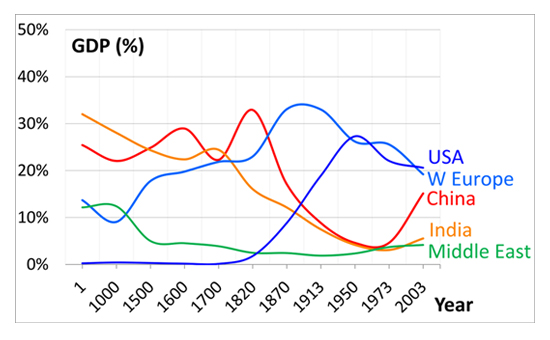
Prof. Maddison collected a lot of data over many years. The best way to understand what he found is by looking at the chart below (4).

Looking at this chart, we can make the following observations:

1. India was the most prosperous country for the first 1,500 years of the Current Era

2. India’s share of the global GDP started plummeting from a high of 25% since late 1700 all the way to under 5% at Independence.

3. After the British entered India and established their regime, the economy of Western Europe increases dramatically from around 1800.

4. After Europeans establish settlements in America and began slavery, a non-existent American economy skyrockets starting in 1800s.

5. The trend for India has been reversing since the 1970’s.

So, if I were to ask the question “How economically prosperous was India 300 years ago”, we should be able to see that “India was as relatively prosperous then as USA is today!”

S. Gurumurthy’s talk at IIT Bombay in 2010 (5) provides a very good introduction to this topic.

Pay closer attention to the economic trends of India and Western Europe. Less than a century after the British entered India and establish themselves firmly, European economy begins skyrocketing for almost 150 years. Raj Vedam (6) says that this is not a coincidence. He attributes this to transference of wealth from India.

Let us see what the plundering British themselves had to say. Robert Clive (1725-74) was the Commander-in-Chief of British India. He created ownership of the lands of what is today India, Pakistan, and Bangladesh, and established a process of funneling wealth out of India to Britain. He said that India was “a country of inexhaustible riches and one which cannot fail to make its masters the richest corporation in the world” (7). At that time, the state of “Bengal” alone, which was the richest “state” in India, was richer than the entire Britain!

When an American philosopher Will Durant visited India in 1930, 175 years after Robert Clive’s planned campaign to destroy India began, Durant was so horrified at the destruction wrought by the British (8) that, instead of pursuing his goal of writing his book “The Story of Civilization”, he took up writing to inspire Indians to fight for Independence. In what he terms as “The Rape of a Continent”, he says “But I saw such things in India as made me feel that study and writing were frivolous things in the presence of a people-one-fifth of the human race – suffering poverty and oppression bitterer than any to be found elsewhere on the earth…” Raj Vedam highlights actions by the British that choked India (6).

●The cost of British conquests (including first and second world wars), developments in Britain, and administration of India, were all charged to Indians.

●Indians were forced to sell cheap and buy exorbitantly.

●Indians were taxed twice as high as in England and thrice as in Scotland.

●Millions of dollars’ worth of bribes from rulers who were dependent on favours and guns.

Hence, it is accurate to say that the British rule decimated Indian economy and ruined India. Yet, today, our children are taught that it is “the caste oppression” that made India poor!

In conclusion, India was one of the most economically prosperous countries in the world for a good bit of the known past. The British rule is probably the most significant factor that contributed to India’s poverty.

Let us remind ourselves that “Colonization” is never beneficial for the colonized people. If we study history properly, we will likely find that every colonized country was culturally and economically prosperous, and each such country is in various states of struggle or ruin today.

References

1. “World Economic Outlook Database“, International Monetary Fund, 17 April 2018.

2. “PM Narendra Modi seeks double-digit GDP growth, raising India’s share in world trade”, The Economic Times, June 22, 2018.

3. Maddison A, “Contours of the World Economy 1-2030 AD”, Oxford University Press, 2007.

4. Hunter, Tracy M., Own work, CC BY-SA 4.0,

5. S. Gurumurthy, speech at IIT Bombay Hindustan Times Avenue 2010 (Full),

6. Raj Vedam, “Indian civilization: The Untold Story”, Talk at Srijan Foundation, New Delhi, February 2018.

7. J. Albert Rorabacher, “Property, Land, Revenue, and Policy: The East India Company, C.1757–1825”, Routledge, 2017.

8. Will Durant, “The Case for India”, Simon and Schuster, New York, 1930.Also read

Continue Reading

articles

Why not Conserve? Delving into the Ground Realities of Conserving Unprotected Heritage in India

Published

on

By

About the Article Author - Protyoy Sen

Protyoy Sen is an architect, currently pursuing his Masters in Building Conservation at the Welsh School of Architecture, Cardiff University. Having graduated from CEPT University Ahmedabad in 2023, his primary interest lies in the tangible values of conserving heritage, incentivisation for its stakeholders, and aligning conservation with broader goals of urban planning and sustainability. He believes that the potential of heritage in creating a rooted economy is currently underutilised in India, and attributes his passion to the architectural legacy of his hometown, Calcutta. His earlier research delved into the practical challenges of conserving heritage buildings, and its quantifiable benefits for the society.

Protyoy also has over two years of experience in the industry, having worked with Indian heritage bodies such as INTACH and DRONAH. His work, during this time, included projects with private clients, Archaeological Survey of India (ASI), and State Archaeology and Tourism departments.

Continue Reading

articles

Prayagraj and Its Sacred Glory (Prayāga Māhātmya)

Published

on

By

About the Article Author - Jitendra Tiwari

Jitendra Tiwari is a committed educator and cultural practitioner devoted to the service of Bharat through the revival and application of its eternal civilizational wisdom. His work consciously integrates education, heritage conservation, and sustainable rural development, aiming to harmonize tradition with meaningful service to society.

He served for five years as Headmaster at Govardhan Gurukul, Govardhan Eco Village, where he was deeply involved in value-based education, character formation, and community development initiatives. At present, he teaches Mathematics and English at a Gurukul in Parmanand Ashram, Prayagraj. His teaching journey—spanning Prayagraj and earlier experience in Mumbai—has strengthened his resolve to nurture disciplined, holistic learning among students, shaping them into responsible future leaders of society and the nation.

Through the Sri Adishankaracharya Foundation, he actively works to promote Panchgavya-based organic farming, cow protection, farmer and artisan empowerment, and digital documentation of Bharat’s rich heritage. He also curates heritage walks in Prayagraj and develops educational modules and guidebooks grounded in the region’s sacred history and cultural legacy.

Deeply inspired by the teachings of great Acharyas—especially Jagadguru Shankaracharya Swami Nishchalanand Saraswati Maharaj—Jitendra Tiwari views his life’s work as a humble offering toward the protection, propagation, and lived practice of Bharat’s cultural and spiritual heritage.


Continue Reading

articles

Sangam and Kumbh Mela in Bengal: The Sacred Legacy of ‘Dakshin Prayag’ Tribeni

Published

on

By

About the Article Author - Pallab Mondal

Pallab Mondal is an independent researcher and columnist with a keen interest in cultural and social issues. A committed cultural and social activist, his work focuses on engaging with society through research, writing, and grassroots perspectives. He holds an MA in Social Work from Rabindra Bharati University, which informs his analytical approach and active involvement in social and cultural discourse.


Continue Reading

Trending

Designed by ihar © 2025