Connect with us

articles

When Did We First Celebrate Makar Sankranti?

Published

on

SNAPSHOT

If Makar Sankranti indeed celebrates the Winter Solstice, how far back in time did we develop the knowledge to understand the significance of the event? Here, Dr Raj Vedam uses knowledge from astronomy, scriptures, paleobotany and other disciplines to arrive at an answer.

The widespread celebration of the Makar Sankranti festival and its many regional variations hint at great antiquity. In this article, we will take a journey through time, weaving together history, astronomy, calendars, seasons, agriculture and common customs, to find connections and understand the antiquity of the festival, and as an outcome, we will examine three different synchronisms for Makar Sankranti.

We first discuss points of astronomical significance, to appreciate the antiquity of the festival.

1. As the Earth rotates on its 23.5 degree tilted axis from west to east, it would appear that celestial bodies that rise in the eastern horizon set in the western horizon, except for the stars closer to the celestial North (South) Pole that would appear to circle it.

2. Earth’s annual revolution around the Sun while tilted at 23.5 degrees gives the phenomenon of seasons, due to the changing amounts of sunlight in each hemisphere, in each quarter segment of the revolution.

3. The visible stars are so distant from our solar system that they appear to be fixed with respect to the Earth’s revolution. As the Earth makes progress in its revolution each day, it would appear that the familiar constellations also change in the sky. Thus the constellations that appear in the night sky in a given month will repeat in a year’s time (ignoring the slow effect of precession, discussed in point 7). The situation is analogous to looking outside a train window on a circular track – the same scenery will appear at the same point on the circular track.

4. Due to the Earth’s tilt at 23.5 degrees, from an Earth-bound observation point, it would appear that the sunrise is offset by a small amount daily, and reaches a southernmost point – the Winter Solstice, and reverses course, and reaches a northernmost point, the Summer Solstice. Ancient Indians recognized the six-month southern journey of the Sun as Dakshinayana, and the 6-month northern journey as the auspicious Uttarayana. The epic Mahabharata, recounts Bhishma who could control the time of his death, and lay on a bed of arrows, waiting for the start of Uttarayana, for more than 92 days (Nilesh Nilakanth Oak, When Did the Mahabharata War Happen?), hinting ancient observance of the Winter solstice occurrence.

5. Indian astronomical work divided the sky into twenty-seven Nakshatras that each occupies 13 and 1/3 degree segments, approximately the distance traveled by the Moon in a 24 hour period against the fixed stars. Each Nakshatra was identified by the principal stars in that segment of the sky. The Nakshatra model forms part of the earliest corpus of Indian works on astronomy, dating to the Vedic era.

6. In addition to the twenty-seven Nakshatras, ancient Indians also divided the sky into 12 equal parts of thirty degrees each, called the Rashis. While there have been some Western assertions that ancient Indians borrowed the Rashi model from Babylon, Subhash Kak shows otherwise in his book, Astronomical Code of the Rgveda, about the Vedic origin of the Rashis, evolving from the twelve Adityas. See fig.1.

 
The twelve Rashis shown on the ceiling of the 12th century Airavatesvara temple in Darasuram, Tamil Nadu.


The twelve Rashis shown on the ceiling of the 12th century Airavatesvara temple in Darasuram, Tamil Nadu.

7. Due to the gravitational effects of Sun and Moon (and to a lesser extent, Venus, Jupiter and Saturn), the Earth wobbles on its axis, and completes a non-uniform cycle in about 25,771 years, referred to as Precession of Equinox. Due to this wobble, the celestial North Pole (and South Pole) appears to change over time, and the Rashis appear to drift slowly over the years. More than 2500 years ago, ancient Indians had observed and measured the wobble at a degree for every 100 years. This translates to a measure of 36,000 years, a figure repeated by Hipparchus around 150 BCE. One of the best estimates of Precession was made by Bhaskara II of Ujjain in the 12th century, to 25,461 years, and not improved upon till modern times. It is very interesting that ancient Indians had noted a time when Abhijit (the star Vega) was once the pole-star, and also a time when it was no longer the pole-star. Abhijit was at the Celestial North Pole approximately 14,000 years ago. Around 7000 years ago, it would have appeared to have “fallen” in the sky, as noted by Dr. P.V.Vartak (in Scientific Dating of Ramayana and the Vedas), calling out a reference to a passage in the Mahabharata.

We now define Makar Sankranti as the date when from an Earth-bound observation point, the Sun enters the Makar Rashi, also called Capricorn.

Ancient Indians noted the Winter Solstice as the start of the auspicious Uttarayana. At some point in the past, Uttarayana coincided with Makar Sankranti, and constitutes our first point of synchrony. We can determine the time period when the two coincided by considering the effects of Precession. Prior to that, it is instructive to note how ancient Indians and Europeans recorded the passage of time.

Subhash Kak notes that even before Vedanga Jyotish, ancient Indians’ 27-Nakshatra and 12 Rashi system used a luni-solar calendar where every 5 years, an additional month called Adhika Masa was added, synchronizing the lunar and solar years. Ancient Indians also estimated the tropical year, defined as the period when the Sun enters the same seasonal point – say, a solstice point.

Aryabhata and Bhaskara II had estimated the tropical year at 365 days, 6 hours, 12 minutes, and 30 seconds, the same figure as estimated in the ancient Indian text, Surya Siddhanta. The modern figure for the tropical year is approximately 365 days, 5 hours, 48 minutes and 45 seconds.

In the Western system, Julius Caesar instituted the Julian calendar in 46 BCE, dividing the year of 365 days to 12 months, and adding a day every 4th year, thus averaging to 365 days, 6 hours – a figure less accurate than the Surya Siddhanta. Due to this approximation, this calendar accumulated errors over the years, causing a “slip” in the dates of the equinoxes and solstices. The modern Gregorian calendar introduced in 1582, introduced a correction, where if a year is integer-divisible by 4, it is considered a leap year, except for those centurial years that are integer-divisible by 100, and with further overruling exception to those centurial years that are integer-divisible by 400, which were considered as leap years. With the modern Gregorian calendar, the equinoxes and solstices occur on approximately the same date each year, and considering Precession, has an error of about 1 day every 7700 years.

Considering the first synchrony, the Winter solstice today coincides with the Dhanus Sankranti – one Rashi away from Makar. This slip has happened due to the Precession noted earlier.

 
Position of the Sun in relation to the Rashis on Winter solstice, Dec 21st, 2016. Because of Precession, it is a Dhanus Sankranti, rather than a Makar Sankranti.


Position of the Sun in relation to the Rashis on Winter solstice, Dec 21st, 2016. Because of Precession, it is a Dhanus Sankranti, rather than a Makar Sankranti.

Assuming a uniform Precession rate of 25,771 years for a full circle of 360 degrees, each degree is about 71.5861 years. Rounding the figures and noting that each Rashi occupies 30 degrees, we multiply 72 by 30 to get 2160 – the approximate number of years in the past, when due to Precession, Makar Sankranti would have coincided with the Winter Solstice, approximately in 143 BCE. By simulation in planetarium software, we find that anywhere from 400 BCE to the opening centuries of the Common Era, the Winter solstice date would have coincided with the Sun rising approximately in Makar Rashi. Based on synchrony of the solstice with Makar Sankranti, we propose the festival to have been celebrated since 400 BCE. See figs. 3 and 4.

 
Position of the Sun in relation to the Rashis on Winter solstice, Dec 25th, 400 BCE. Notice that the Sun rise is in Makar Rashi, making it a Makar Sankranti.


Position of the Sun in relation to the Rashis on Winter solstice, Dec 25th, 400 BCE. Notice that the Sun rise is in Makar Rashi, making it a Makar Sankranti.
 
Notice the position of the Sun at 7AM on Jan 14th, 2017, and how 7 days later, it is at the Makar Rashi. Considering Precession, 505 years ago, Makar Sankranti would have been on Jan 14th – exactly the time of Kerala Astronomer, Nilakantha Somayaji, 1512 CE.


Notice the position of the Sun at 7AM on Jan 14th, 2017, and how 7 days later, it is at the Makar Rashi. Considering Precession, 505 years ago, Makar Sankranti would have been on Jan 14th – exactly the time of Kerala Astronomer, Nilakantha Somayaji, 1512 CE.

Our second dating of the antiquity of the Makar Sankranti festival is by considering the synchrony of Makar Sankranti with the Til/Sesame/Gingelly crop harvest. We notice an India-wide common aspect of celebrating Makar Sankranti – the widespread use of til in traditional sweet preparation. Til is a drought-resistant rabi crop in India, planted currently around mid-November and harvested in April, before the monsoons, taking about 90 to 120 days to grow. Paleo-botanical records suggest an antiquity of at least 3000 BCE for the multi-crop cultivation of til in Rakhigarhi sites and a few centuries later for domestic rice, and trade with Mesopotamia and Egypt in til in 2000 BCE. Up to the medieval period, Indian farmers encoded agricultural wisdom with references to nakshatras to help time their planting and reaping activities. It is fascinating to investigate a period of time when Makar Sankranti coincided with the harvest of the til crop, say in southern India, and was therefore used in celebratory sweet preparation.

Contrary to popular thought, the seasons do not change with Precession. The Milankovitch cycles predict long-term climate changes due to Precession, Obliquity and Tilt cycles of the Earth, but these do not impact the periodical seasons (might make seasons more or less severe, though!). However, if we peg our measurement of time to a Nakshatra/Rashi, that observation can change over time due to Precession. Thus an observation that “rainy season starts in Ashada Masa” can change over time due to Precession.

Our clue is that traditionally, Makar Sankranti is considered as a harvest festival. In Tamil Nadu, there are two planting seasons for Til – Thai Pattam (Jan/Feb) and Adi Pattam (July/August). Considering a 4-month growing period, the Adi Pattam crop harvest would coincide with December. Thus again, the date of about 400 BCE synchronizing the Winter solstice, Til harvest, and Makar Sankranti makes sense.

The final synchrony we examine is to ask the question, when did Makar Sankranti last coincide with Jan 13th/14th? By direct simulation on planetarium software, we find this date to be around 1500s CE. This period is startlingly, the exact period of the famous Kerala astronomer, Nilakantha Somayaji (1444-1544), author of Tantrasangrama, who would have been aware of the length of the tropical year and the effect of Precession from works of Aryabhata, Bhaskara II as well as Surya Siddhanta, and might have computed the date accordingly. This date was probably left untouched since. See figure 4.

We have examined three synchronies regarding Makar Sankranti. The first, based on synchrony with the Winter Solstice gives a date of about 400 BCE. The second, based on a synchrony of til harvest in Tamil Nadu with Makar Sankranti also suggests 400 BCE. The third, based on a synchrony with the tropical calendar, gives a date of 1500s CE.

As we celebrate Makar Sankranti, we should also celebrate the strong traditions of astronomy and mathematics, indelibly tied with the shared experience of the nation, over thousands of years.

Continue Reading

articles

CARVING CONTINUITIES: THE LIVING HERITAGE OF SOAPSTONE ARTISANS

Published

on

Soapstone carving is a remarkable craft whose origins stretch back to some of the earliest civilizations in India. Today, this artistic tradition continues among communities whose heritage and skills have been passed down for many generations.

Historical Roots

Soapstone, a metamorphic rock primarily composed of talc, has been used in the Indian subcontinent since the days of the Indus-Saraswati Civilization and the Chalcolithic period. Its historical significance is evident in ancient sites where artifacts such as seals, beads, statues, and small figurines have been found. Key archaeological discoveries, like steatite ringstones from the Shunga-Maurya period and sculptures from the Gupta era, illustrate soapstone’s profound role throughout history. The artistry of temple construction, as seen in Khajuraho, Jabalpur, and Udaipur, is just one facet of the stone’s legacy, with temple artisans employing techniques and tools that are still in use by contemporary soapstone carvers.

Community and Continuity

Carving skills within artisan communities—particularly the Silawat and Vishwakarma—are shared orally and inherited over generations, often spanning four to five generations. Despite the richness of these traditions, written documentation remains scattered and incomplete, making oral testimonies vital in preserving the craft’s continuity. Migration patterns have also contributed to the dispersion and evolution of carving techniques among artisans.

Diversity of Soapstone Craft

The types of sculptures crafted by soapstone artisans are diverse, shaped by regional demands and socio-economic conditions. These range from modern decorative pieces to ritualistic art:

– In Jabalpur (Madhya Pradesh), artisans produce devotional and decorative items such as cookware, toys, and showpieces, with motifs including Shivlings, demigods, elephants, and birds. Soapstone for these works is typically sourced from mines near Bhedaghat.

– The Jhabua-Alirajpur region is known for traditional Gaata sculptures crafted in a relief style, often created in memory of deceased males and worshipped with offerings. Local mines, as well as sources in Gujarat and Rajasthan, supply the necessary soapstone.

– Udaipur’s artisans have adapted to high tourist demand, blending traditional motifs with contemporary designs. Lord Ganesh idols, abstract human figures, and various souvenirs showcase the community’s ability to innovate while maintaining cultural resonance.

Methods and Techniques

Soapstone carving is a collaborative and systematic process :

– Artisans begin with the selection and cutting of raw soapstone using cutters.

– Shaping is performed with hammers and chisels to form the sculpture’s basic structure.

– Fine chisels refine features, while detailing is achieved with pointed tools for intricate patterns.

– Female artisans often smoothen the finished sculptures using sandpaper and water, ensuring a flawless texture.

– Final touches, such as polishing and coloring, are applied with waterproof primers, oil-based substances, or spray paints for gloss and durability.

Cultural Significance and Challenges

The living heritage of soapstone carving continues to hold deep cultural value, maintaining links between the artisans of central and western India since the Bronze Age. Knowledge is primarily transmitted orally, but today faces threats from the rise of mechanization and waning interest among younger generations. Seasonal changes in tourism and market access impact sales, though affordable raw material provides some relief.

The Way Forward

There is an urgent need to recognize, support, and safeguard soapstone artisans to preserve this craft for future generations. Without such efforts, a vital aspect of India’s creative and spiritual history risks fading away. By understanding and promoting the work of these artisans, society can ensure the survival of this unique and profound tradition.

Continue Reading

articles

CONSTRUCTING GENDER IDENTITIES IN DEATH : RETHINKING MORTUARY ARCHAEOLOGY THROUGH THE EVIDENCE OF SINAULI

Published

on

The archaeological site at Sinauli in Uttar Pradesh has provided significant insight into ancient burial practices, gender identities, and social hierarchy in South Asia. The evidence uncovered at Sinauli challenges long-held assumptions and offers fresh perspectives on mortality, gender roles, and elite status in ancient Indian society.

Location and Historical Context

Sinauli is situated in the Baghpat district of western Uttar Pradesh, lying within the fertile Upper Ganga-Yamuna Doab region. It is associated with the Ochre Coloured Pottery (OCP) culture, which dates back to the early second millennium BCE. This site gained attention due to its unique burial practices, especially those involving women and the material assemblages found with their graves.

Overview of Excavations

The Sinauli excavations were initiated in 2005 under archaeologist D.V. Sharma, and further work was conducted in 2018 by Dr. Sanjay Manjul. In 2005, archaeologists uncovered 116 burials, typically oriented north-south, along with ochre-colored pottery. The 2018 excavations revealed even greater complexity, including wooden coffins adorned with copper sheets, rectangular boxes, antenna swords, helmets, shields, pots, and controversial wheeled vehicles—leading to a debate over whether these were chariots or carts.

Types of Burials

Sinauli yielded four primary burial types:
– Symbolic burials without skeletons.
– Primary burials with full skeletons.
– Secondary or fragmented burials.
– Multiple burials containing fragmented remains.

Gender Distinctions in Burial Practices

A significant contribution of Sinauli is its challenge to conventional views on gender and mortuary archaeology. Certain burials, notably those identified by Asko Parpola, show that elite women were sometimes interred in richly decorated coffins with martial symbols such as swords, shields, and wheeled vehicles. Coffins for women featured steatite inlay and were often covered, in contrast to men’s coffins, which generally had copper sheathing and were left uncovered. Such differentiation suggests elaborate symbolism surrounding gender and possibly ritual seclusion or heightened sacredness for women in death.

One highly debated aspect is the absence of feet in Burial-1, which might suggest less earthly mobility or represent a transformation from earthly to transcendent status.

Rethinking Weaponry and Gender

The presence of weapons, such as copper antenna swords and shields, in women’s graves at Sinauli has prompted scholars to reconsider rigid notions of gender roles. These martial objects could signal the dead’s authority—either as warriors or ritual leaders—thus broadening our understanding of gender within ancient funerary contexts. Interestingly, such elaborate martial symbolism is less prevalent in the male burials at Sinauli.

Symbolism of Coffins and Elite Status

Coffins at Sinauli, rare in South Asian archaeology, were more than mere containers; they symbolically transformed the deceased into sacred beings. Their intricate decoration reflects considerable labor, resources, and craftsmanship, indicating elite status and the possibility of gendered authority within the social hierarchy.

Conclusions and Implications

The burial evidence from Sinauli emphasizes material distinctions that reveal social stratification, hierarchy, and constructed gender roles. While the idea of women warriors remains debated, the presence of martial symbols with elite women points towards complex rituals and conceptions of social power in death. Sinauli thus stands out as a crucial site for rethinking gender identities, social class, and the symbolic aspects of funerary practices in ancient India.

Continue Reading

articles

Rediscovering Sutanuti: IHAR WB CHAPTER’S Second Heritage Walk

Published

on

On Sunday, October 26, 2025, the organization Indian History Awareness and Research (IHAR) embarked on its inaugural heritage walk, titled “Rediscovering Sutanuti.”
Dedicated to the study, research, preservation, and public awareness of Indian history, IHAR has long aimed to connect people with the layers of India’s historical and cultural legacy. This heritage walk marked a significant step in that direction.

Why Sutanuti?

The choice of Sutanuti as the focus of IHAR’s first heritage walk was profoundly symbolic.
It was here, on August 24, 1690, that Job Charnock, an officer of the East India Company, is believed to have landed—a moment that would reshape the destiny of Bengal and, indeed, the entire Indian subcontinent.
Although the Company had visited Sutanuti earlier, it was this arrival that initiated a chain of events culminating in nearly two centuries of colonial rule, lasting until August 14, 1947.

On November 10, 1698, the East India Company entered into an agreement with the Sabarna Roy Chowdhury family, acquiring the zamindari (lease rights) of three villages—Kalikata, Govindpur, and Sutanuti—for an annual rent of ₹1300.
This agreement laid the foundation for the rise of Calcutta, though Charnock himself never witnessed it, having passed away in 1693.

Over 335 years later, the Sutanuti of 1690 and that of 2025 appear worlds apart.
Historians still debate the precise locations of Sutanuti Ghat, where Charnock’s ship is believed to have anchored, and Sutanuti Haat, the bustling market once held twice a week for the sale of cotton yarns and threads.
It was this very market that enriched the Seths and Basaks, the early inhabitants of Calcutta, through the textile trade.

Though no physical trace of that port or market survives today, scholars generally agree that Sobhabazar corresponds to the original Sutanuti region.
Accordingly, IHAR chose this locality for its first heritage walk—a symbolic return to the city’s historical roots.

The legacy of Sutanuti lives on in names like Haatkhola (“the open market”), a term derived from the old marketplace and still preserved in local designations such as Haatkhola Post Office.
Similarly, through the efforts of Sutanuti Parishad, the Sobhabazar Metro Station was officially renamed “Sobhabazar Sutanuti.”
Even in the absence of the old market, these surviving names echo the deep emotional and cultural resonance Sutanuti continues to hold for the people of Calcutta and Bengal.

Highlights of the Walk

The heritage walk took participants on a journey through Sutanuti’s remaining landmarks and forgotten corners, each revealing a fragment of Calcutta’s layered past.

B. K. Pal’s House

The first stop was the residence of B. K. Pal, the pioneering Bengali manufacturer and seller of medicines in the 19th century.
His most celebrated creation, Edward Tonic (1887), became a household remedy for fevers and stomach ailments—common and often fatal in colonial Calcutta—earning him a lasting place in Bengal’s medical history.

Shwet Kali Temple

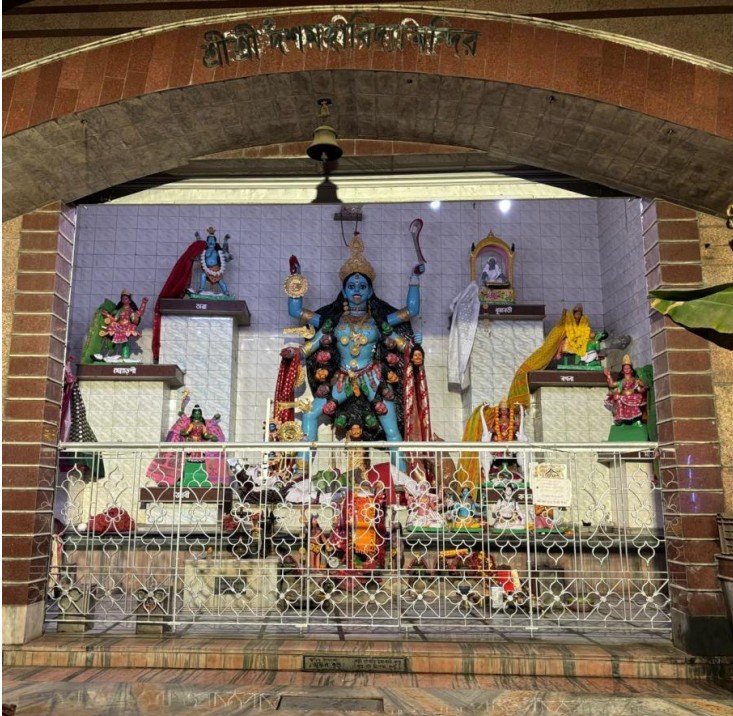
Participants then visited the Shwet Kali Temple on Sobhabazar Street, nearly 300 years old and among the three oldest white Kali temples in Bengal.
Originally a shrine for dacoits, it later became a site of domestic worship. The deity here is distinctive—white in color, two-armed, tongue inside the mouth, and standing over Virupaksha and Kalbhairav, without the usual garland of severed heads.

Raja Janakinath Ray’s Mansion

The walk next stopped at the grand mansion of Raja Janakinath Ray of the Bhagyakul Ray family, prosperous traders from Dhaka and Calcutta.
Built in the 19th century, a part of this palatial building now serves as the Jorabagan Traffic Guard office, while descendants of the Ray family still occupy another section.

Chitpur Road (Rabindra Sarani)

Participants then walked along Chitpur Road, now Rabindra Sarani, regarded as Calcutta’s oldest road, dating back nearly 500 years.
Originally extending from Chitpur to Kalighat and later to Halisahar, the path once cut through dense forests inhabited by wild animals and robbers—an incredible contrast to today’s bustling thoroughfare.

Rameshwar Shiva Temple

Next came the Rameshwar Shiva Temple, built around 1700 by Nandaram Sen, the first native tax collector under the British official Mr. Sheldon.
Standing 80 feet tall, the temple mirrors the Aatchala style of the Kalighat Kali Temple and houses a six-foot-high Shivalinga.

Kumartuli and the Artisans

The walk then entered Kumartuli, where artisans were crafting Jagaddhatri idols.
Participants met Amit Ranjan Karmakar, a rare collector and restorer of vintage radios, tape recorders, and gramophones—all maintained in working order.

Radhagobinda and Baneshwar Shiva Temples

The Radhagobinda Temple and the Aatchala Baneshwar Shiva Temple, built by Bonomali Sarkar, another British-era official, were the next stops.
While the Radhagobinda Temple remains in fair condition, the Baneshwar Shiva Temple lies in neglect, its once-fine terracotta work fading amid weeds.

Kaviraj Gangaprasad Sen’s House

The group then visited the home of Kaviraj Gangaprasad Sen, the eminent 19th-century Ayurvedic physician who migrated from Bikrampur (Dhaka) in 1840.
Revered for his skill, he once treated Sri Ramakrishna Paramahansa and famously predicted that the saint’s illness was incurable—a prophecy now part of Bengal’s spiritual lore.

Dhakeshwari Temple

The Dhakeshwari Temple in Kumartuli houses a 800–1000-year-old ashtadhatu idol, originally enshrined in Dhaka by King Ballal Sen.
After Partition, the idol was smuggled to Calcutta in 1948 and relocated to its present temple in 1950, where it continues to be worshipped.

Madanmohan Temple

The majestic Madanmohan Temple, established in 1761 by Gokul Chandra Mitra, came next.
Once spread across 56 bighas, the temple houses a black stone deity associated with a legend involving King Chaitanya Singh of Mallabhum.
Its Raas and Annakut festivals are still celebrated annually.

Siddheshwari Mata Temple and the Black Pagoda

The final stop was the Siddheshwari Mata Temple in Baghbazar, believed to be over 500 years old.
Founded by a monk named Kalibor, it later came under the worship of the Chakraborty family and their descendants.
The goddess, affectionately known as “The Ginni Maa of Baghbazar,” was revered even by Girish Ghosh and Sri Ramakrishna, the latter once offering tender coconuts for the recovery of Keshab Chandra Sen.

Across the street stands the Black Pagoda, constructed between 1725 and 1730 by Govinda Ram Mitra, the second native revenue collector after Nandaram Sen.
Standing originally over 165 feet tall, it once surpassed even the Ochterlony Monument (Sahid Minar) in height before being partially destroyed in the cyclone of 1737.
Its surviving fragments still whisper tales of Sutanuti’s lost grandeur.

A Journey Through Memory

Thus concluded IHAR’s first heritage walk—a journey through the forgotten heart of Sutanuti, where every lane, temple, and crumbling mansion still bears the faint echo of Calcutta’s beginnings.
Though time has erased much of the physical landscape, the spirit of Sutanuti endures—in its names, in its memories, and in the hearts of those determined to rediscover it.

Continue Reading

Trending

Designed by ihar © 2025