Connect with us

articles

CONSTRUCTING GENDER IDENTITIES IN DEATH : RETHINKING MORTUARY ARCHAEOLOGY THROUGH THE EVIDENCE OF SINAULI

Published

on

The archaeological site at Sinauli in Uttar Pradesh has provided significant insight into ancient burial practices, gender identities, and social hierarchy in South Asia. The evidence uncovered at Sinauli challenges long-held assumptions and offers fresh perspectives on mortality, gender roles, and elite status in ancient Indian society.

Location and Historical Context

Sinauli is situated in the Baghpat district of western Uttar Pradesh, lying within the fertile Upper Ganga-Yamuna Doab region. It is associated with the Ochre Coloured Pottery (OCP) culture, which dates back to the early second millennium BCE. This site gained attention due to its unique burial practices, especially those involving women and the material assemblages found with their graves.

Overview of Excavations

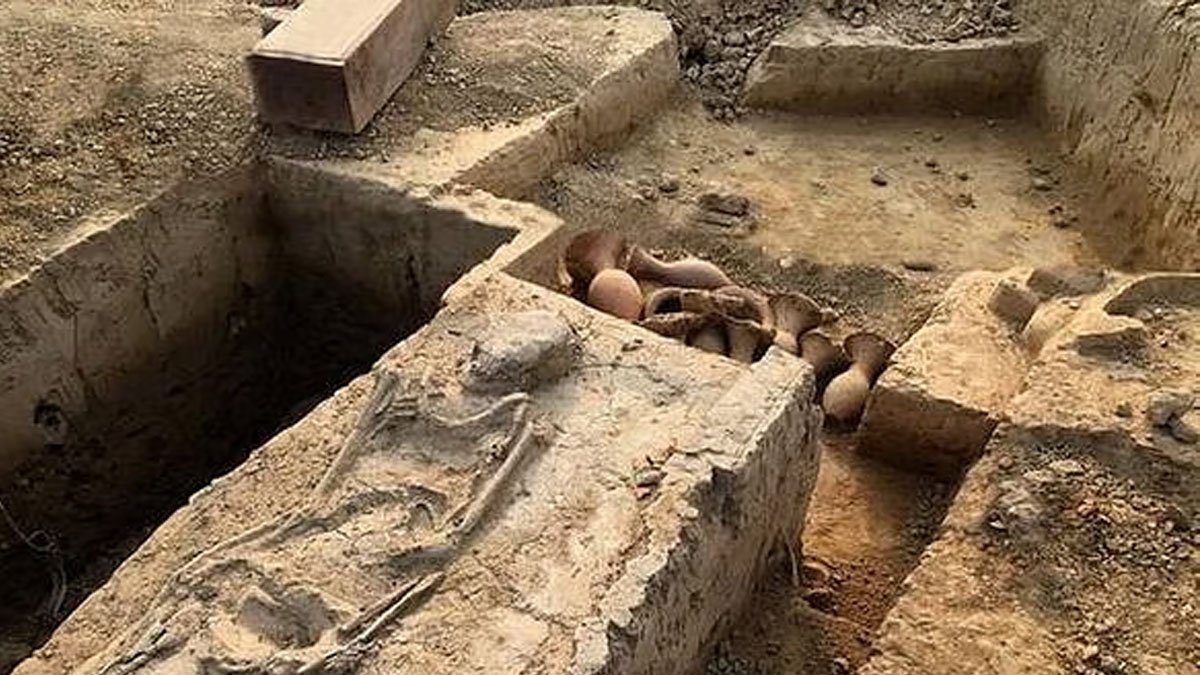
The Sinauli excavations were initiated in 2005 under archaeologist D.V. Sharma, and further work was conducted in 2018 by Dr. Sanjay Manjul. In 2005, archaeologists uncovered 116 burials, typically oriented north-south, along with ochre-colored pottery. The 2018 excavations revealed even greater complexity, including wooden coffins adorned with copper sheets, rectangular boxes, antenna swords, helmets, shields, pots, and controversial wheeled vehicles—leading to a debate over whether these were chariots or carts.

Types of Burials

Sinauli yielded four primary burial types:
– Symbolic burials without skeletons.
– Primary burials with full skeletons.
– Secondary or fragmented burials.
– Multiple burials containing fragmented remains.

Gender Distinctions in Burial Practices

A significant contribution of Sinauli is its challenge to conventional views on gender and mortuary archaeology. Certain burials, notably those identified by Asko Parpola, show that elite women were sometimes interred in richly decorated coffins with martial symbols such as swords, shields, and wheeled vehicles. Coffins for women featured steatite inlay and were often covered, in contrast to men’s coffins, which generally had copper sheathing and were left uncovered. Such differentiation suggests elaborate symbolism surrounding gender and possibly ritual seclusion or heightened sacredness for women in death.

One highly debated aspect is the absence of feet in Burial-1, which might suggest less earthly mobility or represent a transformation from earthly to transcendent status.

Rethinking Weaponry and Gender

The presence of weapons, such as copper antenna swords and shields, in women’s graves at Sinauli has prompted scholars to reconsider rigid notions of gender roles. These martial objects could signal the dead’s authority—either as warriors or ritual leaders—thus broadening our understanding of gender within ancient funerary contexts. Interestingly, such elaborate martial symbolism is less prevalent in the male burials at Sinauli.

Symbolism of Coffins and Elite Status

Coffins at Sinauli, rare in South Asian archaeology, were more than mere containers; they symbolically transformed the deceased into sacred beings. Their intricate decoration reflects considerable labor, resources, and craftsmanship, indicating elite status and the possibility of gendered authority within the social hierarchy.

Conclusions and Implications

The burial evidence from Sinauli emphasizes material distinctions that reveal social stratification, hierarchy, and constructed gender roles. While the idea of women warriors remains debated, the presence of martial symbols with elite women points towards complex rituals and conceptions of social power in death. Sinauli thus stands out as a crucial site for rethinking gender identities, social class, and the symbolic aspects of funerary practices in ancient India.

articles

The Trail of Omkari : A Spiritual Corridor of Bangla Shaktipeeths

Published

on

By

About the Article Author - Dr. Mrittunjoy Guha Majumdar

Dr. Mrittunjoy Guha Majumdar, Chair – IHAR Science Committee, is an Adjunct Professor at the National Institute of Advanced Studies Bengaluru and Assistant Professor at Amrita Vishwavidyapeetham, Delhi NCR. Having completed his doctorate from Cavendish Laboratory at the University of Cambridge, he has been an institutional postdoctoral fellow at Harvard University, a senior postdoctoral researcher at the Indian Institute of Science – Bangalore (funded by the Office of the Principal Scientific Advisor to the Government of India) and a postdoctoral associate of Nobel Laureate (Physics, 1973) Prof. Brian Josephson at the University of Cambridge. He has been a Trinity Barlow Scholar (2015-2018), Nehru Scholar (2014-2018), INSPIRE Scholar (2011-2014) and TIFR NIUS Fellow (2012-2014). He was a lead speaker in the domain of quantum error correction at the National Quantum Mission (NQM) strategic consultation meeting in July 2023. His area of research expertise is in entanglement, quantum information and the foundations of quantum physics. He has had training in Artificial Intelligence from the MIT Schwarzmann School of Computing, with one of his recent research focus-areas being Quantum Machine Learning (QML). Dr. Guha Majumdar has previously worked with the Ministry of Human Resource Development (Government of India), UNESCO and G20 on education and science policy. He has also been a science communicator, with his documentary on quantum mechanics aired on Doordarshan, under the Science India initiative. His book ‘From Shiva to Schrödinger’, published by the Penguin Randomhouse group, has been a bestseller. He is the national convenor of Mandala, that intends to bridge contemporary science and Indic thought, in a rigorous and self-consistent manner, at the ontological as well as the epistemological and normative levels.

Continue Reading

articles

Dokra: Folk art of west Bengal

Published

on

By

About the Article Author - Prof. Utkalika Sahoo

Utkalika Sahoo is an Assistant professor at Bangabasi Evening College. Earlier, she has been teaching at Naihati RBC Women’s College since 2010.She did her Masters in History from Jadavpur University and MPhil in the Department of International Relations from Jadavpur University. Currently, she is doing her PhD in the Department of Modern History from Calcutta University. Her PhD topic is Partition Literature. She gives NET SET coaching at Kalyani University. She has written more than 30 articles and books. She also writes articles in foreign newspapers.

Continue Reading

articles

Exploring the Buddha’s Relics: IHAR at Rai Pithora Quila

Published

on

The Indian History Awareness and Research (IHAR) team recently visited the Rai Pithora Quila complex, which is currently hosting a significant exhibition focused on the Pipirawaha discoveries associated with the Buddha’s relics and precious gems. This exhibition marks a landmark initiative by the Ministry of Culture, as it brings together, for the first time, key inventories from both the Indian Museum, Kolkata, and the National Museum, New Delhi.

The central attraction of the exhibition is the Pipirawaha relics and gemstones, presented alongside a detailed archaeological and historical narrative. Visitors are able to understand not only the importance of these relics but also the story of their discovery, excavation, and interpretation over time. The use of high-quality digital displays and archaeological reconstructions makes the presentation engaging and easy to follow for both scholars and the general public.

A major highlight of this exhibition is the collaboration between the Indian Museum and the National Museum. Objects that were earlier displayed separately have now been brought together in a single space, allowing for a more complete understanding of early Buddhist material culture. IHAR expresses its sincere appreciation to Dr Sayan Bhattacharya, Director, Indian Museum for his valuable inputs, which played an important role in making this collaboration possible.

The exhibition also showcases, for the first time in this setting, a wide range of Buddhist iconography and tablets from the National Museum’s collection. These objects demonstrate the development of Buddhist art and symbolism across different periods and regions. Among the most important displays is the famous Nalanda Inscription, which highlights Nalanda’s role as a major centre of learning and its connections with the wider Buddhist world.

Another important aspect of the exhibition is its focus on India’s maritime links with Southeast Asia. Through inscriptions, artefacts, and explanatory panels, the exhibition explains how Buddhist ideas, art forms, and traditions travelled from India to regions such as Southeast Asia via sea routes. This section helps visitors understand Buddhism as a dynamic and expansive tradition shaped by trade, travel, and cultural exchange.

The display of Pala-era manuscripts is another major attraction. These manuscripts include important Buddhist texts, especially versions of the Prajñāpāramitā, and reflect the scholarly and spiritual vibrancy of eastern India during the Pala period. Their inclusion adds a strong intellectual and philosophical dimension to the exhibition, complementing the archaeological displays.

Overall, the exhibition at Rai Pithora Quila presents a well-balanced and thoughtful account of India’s Buddhist heritage. It successfully combines relics, inscriptions, manuscripts, iconography, and digital tools to offer visitors a clear and meaningful understanding of Buddhism’s historical journey within India and beyond.

The IHAR team greatly appreciated the effort taken to present complex historical material in an accessible manner. The exhibition stands out as a model for collaborative museum practice and public history in India.

IHAR is especially proud of the outstanding contribution of its Executive Member, Dr Abira Bhattacharya (Deputy Director Buddhist Gallery, National Museum), whose dedication and expertise played a crucial role in conceptualising and organising this exhibition. Her work reflects IHAR’s broader mission of promoting informed historical research and making India’s rich past accessible to wider audiences.

Continue Reading

Trending

Designed by ihar © 2025